Skip to content

NexGraphHeadless Code Intelligence Engine

Build Knowledge Graphs from Source Code — Let AI Agents Understand Your Entire Codebase

Built for Organizations with Multiple Repositories

Most codebases span multiple repositories — a frontend, a backend API, shared libraries, microservices. Understanding how they connect is critical for code reviews, refactoring, and onboarding.

NexGraph indexes each repository into its own code knowledge graph, then connects them together using cross-repo resolution. This lets AI agents trace execution flows across repository boundaries — for example, from a frontend HTTP call all the way to the backend handler and its database queries.
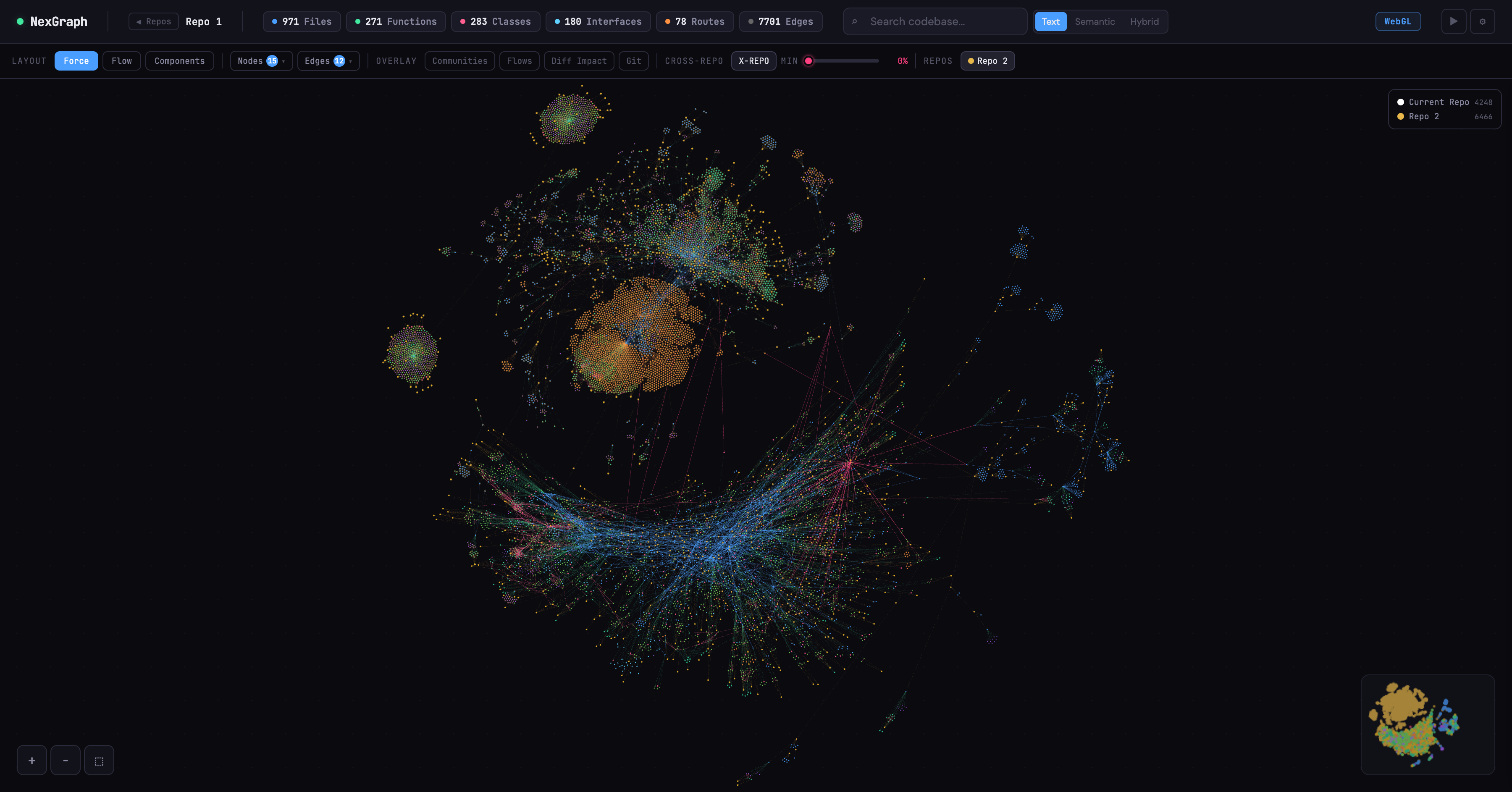
NexGraph cross-repo visualization showing two connected repositories with communities and cross-repo call edges

How It Works

  1. Create a project — group related repositories (frontend, backend, shared libs)
  2. Index each repo — NexGraph parses source code into a knowledge graph (functions, classes, imports, calls, inheritance)
  3. Connect repos — define cross-repo rules (API URL matching, shared types) to link frontend calls to backend handlers
  4. Query via MCP — AI agents use 24 tools to search, trace, and analyze the full codebase — across all repos

Key Capabilities

  • Cross-repo tracing — trace a button click in the frontend through the API call to the backend handler and its database query
  • Impact analysis — change a backend function, see every frontend caller that is affected
  • Community detection — auto-discover functional clusters (auth, payments, users) using the Leiden algorithm
  • Architecture checks — define layer rules, find violations across the entire codebase
  • Multi-language support — TypeScript, JavaScript, Python, Java, Go, Rust — with full call graph extraction for all six

Released under the MIT License.